
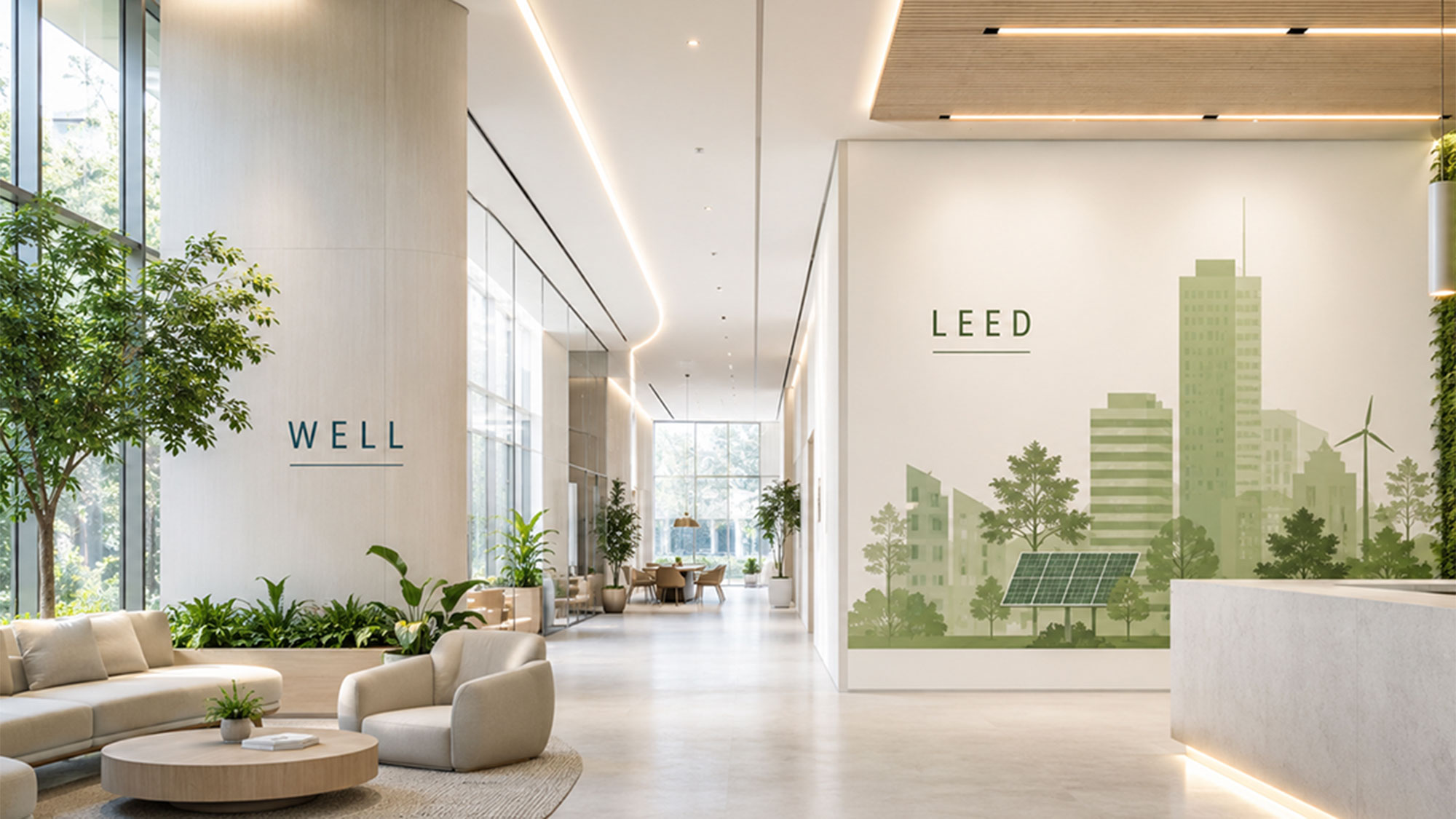
What Lighting Has to Do with WELL and LEED (And Where They Diverge)
A practical guide to specifying lighting for both rating systems without doubling the work
Most commercial projects that pursue one green building certification eventually encounter the other. LEED and WELL both touch lighting, both reference familiar metrics like Color Rendering Index (CRI), Unified Glare Rating (UGR), and Spatial Daylight Autonomy (sDA), and both reward thoughtful controls strategies. But they start from fundamentally different questions.
- Leadership in Energy and Environmental Design (LEED), administered by the U.S. Green Building Council (USGBC), asks how lighting contributes to an efficient, sustainable building.
- The WELL Building Standard, administered by the International WELL Building Institute (IWBI), asks how lighting affects the people inside it.
Those two questions lead to different requirements, different documentation, and occasionally, different design decisions. This guide walks through both systems, identifies where they overlap and where they pull apart, and provides a practical workflow for satisfying both without duplicating your specification effort.
What This Blog Covers
Both rating systems evolve through addenda, pilot credits, and version updates. This article focuses primarily on LEED v4.1 and WELL v2, which represent the versions most active projects are currently using. A brief note on LEED v5 appears at the end. LEED v4.1 and LEED v5 are both currently available for registration; starting July 1, 2026, LEED v5 will be the only version available for new commercial BD+C, ID+C, and O+M registrations, with limited exceptions. Because feature language, thresholds, and numbering can shift between addenda, always confirm requirements against the current published standard for your specific project type and certification path.
The Starting Point: Energy vs. Occupant Health
LEED is a sustainability rating system. Its lighting-related credits span multiple categories: energy performance, indoor environmental quality, and site design. The lighting designer’s primary LEED obligations typically involve reducing lighting power density (LPD) to meet or exceed ASHRAE/IES 90.1 baselines, earning Interior Lighting quality credits, maximizing useful daylight, and controlling exterior light pollution. The emphasis is on efficient, well-controlled lighting that minimizes environmental impact.
WELL is a health and wellness rating system. Its Light concept is an entire category unto itself, with features addressing visual comfort, circadian health, electric light quality, glare, flicker, daylight exposure, and occupant control. Where LEED treats lighting quality as one credit within a larger environmental framework, WELL treats it as a foundational element of occupant wellbeing. The emphasis is on lighting that supports human biology, visual comfort, and individual control.
Neither system is “stricter” in absolute terms. They are strict about different things.
How LEED Looks at Lighting
LEED v4.1 addresses lighting across several credit categories. The most directly relevant to the lighting specification are:
Energy Performance (EA Prerequisite and Credit: Optimize Energy Performance)
Projects must comply with ASHRAE/IES 90.1 for lighting power density. LPD limits set the ceiling on installed watts per square foot, which influences fixture selection, efficacy requirements, and controls strategies. Daylight-responsive controls and occupancy sensors can earn additional energy optimization points.
Interior Lighting (EQ Credit)
This is LEED’s primary lighting quality credit, worth up to 2 points. Projects select from four strategies, needing one strategy for 1 point or three strategies for 2 points. The strategies are glare control (fixture luminance below 7,000 cd/m² between 45° and 90° from nadir, or UGR below 19 via software modeling), color rendering (CRI of at least 90, or IES TM-30 with a Fidelity Index (Rf) of 78 or higher and a Gamut Index (Rg) between 97 and 110), lighting control (dimmable or multilevel lighting for at least 90% of regularly occupied spaces), and surface reflectivity (ceiling reflectance of at least 80% and wall reflectance of at least 55% for at least 90% of regularly occupied spaces).
Daylight (EQ Credit)
Up to 3 points for demonstrating adequate daylight access, typically through sDA modeling (sDA 300/50% thresholds) or illuminance calculations. Annual Sunlight Exposure (ASE) limits help manage glare from direct sun.
Light Pollution Reduction (SS Credit)
Addresses exterior lighting through uplight and light trespass limits, referencing IES/IDA Model Lighting Ordinance (MLO) guidance or BUG (Backlight, Uplight, Glare) ratings.
How WELL Looks at Lighting
WELL v2 organizes its Light concept into multiple features, each addressing a distinct aspect of how light affects occupants. The features most relevant to lighting specification include:
Light Exposure
Encourages indoor daylight access through layout strategies, glazing requirements, or daylight simulation demonstrating sDA thresholds. This feature links daylight availability to both visual and non-visual health benefits.
Visual Lighting Design
Requires that electric lighting in indoor and outdoor spaces meets illuminance thresholds from recognized guidelines such as the IES Lighting Library, ensuring task-appropriate light levels for the occupant population.
Circadian Lighting Design
This is where WELL diverges most significantly from LEED. The feature requires that electric lighting (with or without daylight contribution) achieves minimum melanopic light levels at workstations, measured on the vertical plane at occupant eye level. WELL uses melanopic metrics such as Equivalent Melanopic Lux (EML), with melanopic EDI (M-EDI) also appearing in current documentation. Thresholds vary by tier, space type, and feature path, but the practical implication is clear: the lighting system must deliver enough melanopically effective light at the occupant’s eye during daytime-use periods to support circadian entrainment. LEED has no equivalent requirement.
Glare Control
Addresses both electric and daylight glare. For electric lighting, WELL and LEED both use UGR-based approaches, and current WELL v2 language now aligns with LEED around a UGR 19 threshold for many regularly occupied spaces. WELL may still be more specific in how glare is evaluated by feature path, space type, and luminance limits, so project teams should confirm the current WELL addenda before selecting fixtures.
Electric Light Quality
Covers two areas: color rendering and flicker. For color rendering, WELL provides three compliance paths: CRI of 90 or higher; CRI of 80 or higher with R9 of 50 or higher; or a TM-30 pathway requiring specific Fidelity Index (Rf), Gamut Index (Rg), and red chroma shift (Rcs,h1) values. WELL’s TM-30 path is not just about fidelity and gamut; it also addresses red chroma behavior, making it more specific than the LEED TM-30 pathway. For flicker, WELL requires project teams to document low-flicker performance using recognized standards or metrics, such as California Title 24 JA-10 reduced flicker operation, IEEE 1789 recommended practices, or NEMA 77 metrics such as Pst LM and SVM. LEED has no flicker requirement.
Occupant Lighting Control
Requires that occupants have the ability to adjust lighting in their immediate environment, including dimming, and in some cases, color temperature adjustment. WELL’s control requirements tend to be more prescriptive about individual-level adjustability than LEED’s dimmable-or-multilevel strategy.
Where They Overlap
Both systems care about several of the same lighting attributes, and in some areas, a single design decision can serve both certifications.
Glare control appears in both systems using familiar tools: UGR calculations and luminaire luminance limits. Current WELL v2 addenda and LEED v4.1 both reference a UGR 19 threshold for many regularly occupied spaces, making glare one of the strongest areas of alignment. WELL may evaluate glare through additional feature paths and luminance criteria, but the core metric is shared.
Color rendering requirements converge around CRI 90 and both systems accept TM-30 as an alternative metric. Specifying CRI 90 or higher across regularly occupied spaces is often the simplest shared path for supporting the color rendering strategy in both LEED and WELL.
Daylight access is valued by both, with sDA-based metrics appearing in each system’s daylight features. While the specific thresholds and modeling requirements may differ, the underlying design strategies (glazing optimization, floor plate depth, interior layout) serve both.
Lighting controls and dimmability are rewarded by both systems. Dimmable fixtures with occupancy and daylight-responsive controls contribute to LEED’s energy and interior lighting credits while also supporting WELL’s occupant control and circadian features.
Where They Diverge
The divergences are where specification gets interesting and where teams most often encounter rework or conflicts.
Circadian lighting is the single largest gap between the two systems. WELL requires melanopic light levels measured at the vertical plane at eye level, a metric LEED does not address. Meeting circadian targets may require higher-CCT sources during daytime hours, increased vertical illuminance, or spectrally tuned LED modules, any of which can affect fixture selection, energy use, and the overall lighting design strategy. LEED has no circadian requirement.
Flicker limits exist in WELL but not in LEED. WELL requires project teams to document low-flicker performance using recognized standards such as California Title 24 JA-10, IEEE 1789, or NEMA 77 metrics. Specifiers pursuing WELL need to confirm flicker documentation with driver and fixture manufacturers, which LEED does not require.
Energy and lighting power density are addressed by LEED but not directly by WELL. LEED’s ASHRAE/IES 90.1 compliance sets hard limits on installed watts per square foot. WELL does not cap lighting power. This means a design that achieves WELL’s circadian and visual quality targets must still be checked against LEED’s LPD limits, and the two can occasionally pull in opposite directions: more light for circadian benefit, less power for energy compliance.
Surface reflectance is a LEED Interior Lighting strategy (ceiling reflectance of at least 80%, wall reflectance of at least 55%) that WELL does not directly address. Projects pursuing this LEED strategy need to coordinate with interior design independently of their WELL lighting specification.
Documentation and verification differ in approach. WELL places greater emphasis on verified performance, with WELL Certification involving on-site performance verification and testing by an approved agent. LEED accepts design documentation, calculations, and manufacturer data. This distinction affects project timelines: teams pursuing WELL should plan for post-occupancy testing of light levels, glare, and other measured parameters.
Where Design Tradeoffs Appear
Beyond the “what does each system require” question, there are practical design situations where serving both systems simultaneously creates real tension.
Circadian targets may require higher vertical illuminance, higher CCT during daytime, or spectrally enriched sources, all of which can increase energy consumption and affect LPD compliance. The designer may need to offset circadian lighting power with higher-efficacy fixtures elsewhere in the building or lean more heavily on daylight contribution to meet melanopic thresholds without exceeding energy budgets.
Higher color quality can sometimes reduce luminous efficacy depending on the LED product family. A CRI 90+ source may produce fewer lumens per watt than a CRI 80 source from the same manufacturer, which tightens the LPD budget. The gap has narrowed significantly as LED technology has matured, but it still appears in some product lines, particularly at high lumen packages.
Daylight access supports both systems, but unmanaged daylight can create glare, thermal load, and visual discomfort that work against WELL’s glare control and LEED’s thermal comfort credits. Automated shading, proper glazing selection, and interior layout become critical coordination points.
Advanced occupant controls improve WELL alignment but increase controls coordination, commissioning complexity, and cost. A system that gives every workstation individual dimming and CCT adjustment is more complex to design, install, and commission than one with simple zone-level dimming, even though both may satisfy LEED’s dimmable-or-multilevel strategy.
How to Satisfy Both Without Doubling the Work
The practical workflow is not “pick one system and hope the other follows.” It is a deliberate two-pass approach.
Start with occupant-focused light quality. Specify CRI 90 or higher (or confirm TM-30 compliance) across regularly occupied spaces. Confirm flicker performance across the full dimming range. Select fixtures that meet the more stringent glare thresholds. Establish circadian lighting targets for daytime-occupied spaces and identify where melanopic metrics drive fixture, CCT, or layout decisions. Design occupant controls that satisfy both individual adjustability and zone-level automation. This pass addresses the quality and health side for both WELL and LEED’s Interior Lighting credit.
Then verify energy, daylight, and site requirements against LEED. Check LPD against ASHRAE/IES 90.1 for the applicable edition. Run or confirm daylight modeling with sDA and ASE metrics. Confirm surface reflectance if pursuing that LEED strategy. Verify exterior lighting against light pollution reduction requirements. This pass catches the sustainability and energy-performance side that WELL does not directly address.
For a dual-certification lighting package, plan to collect and organize: luminaire cut sheets with CRI, TM-30, and luminance data; IES photometric files; lighting power density calculations; flicker documentation from driver manufacturers; glare calculations (UGR modeling for WELL, luminance data or UGR for LEED); daylight model outputs (sDA, ASE); controls narratives covering occupancy, daylight harvesting, dimming, and any occupant-level adjustability; dimming schedules and commissioning plans; and any documentation required for WELL performance verification.
LEED v5: The Gap Is Narrowing
LEED v5, which launched in April 2025, signals a shift in how USGBC approaches lighting. The new version consolidates several v4/v4.1 credits, including Interior Lighting, Daylight, Quality Views, Thermal Comfort, and Acoustic Performance, into a Lighting Environment path within the broader Occupant Experience credit. This restructuring moves LEED closer to WELL’s people-centered framing, treating lighting not as an isolated quality metric but as part of a holistic occupant environment. While the specific credit requirements are still being refined and adopted, the direction suggests that future LEED projects will encounter more overlap with WELL’s Light concept than current v4.1 projects do. Teams starting projects now should monitor the LEED v5 credit language closely, particularly if the project timeline extends into 2027 or later.
Bringing It All Together
LEED and WELL are not competing standards. They are complementary systems that ask different questions about the same lighting installation. The most efficient path to satisfying both is not to treat them as separate checklists, but to build a single specification workflow that starts with the most demanding occupant-focused requirements and then verifies performance against the energy, daylight, and site criteria that only LEED addresses.
At LiteSource, we make lighting simple, helping teams turn dual-certification goals into clear, efficient lighting specifications that serve both the building and the people inside it.