
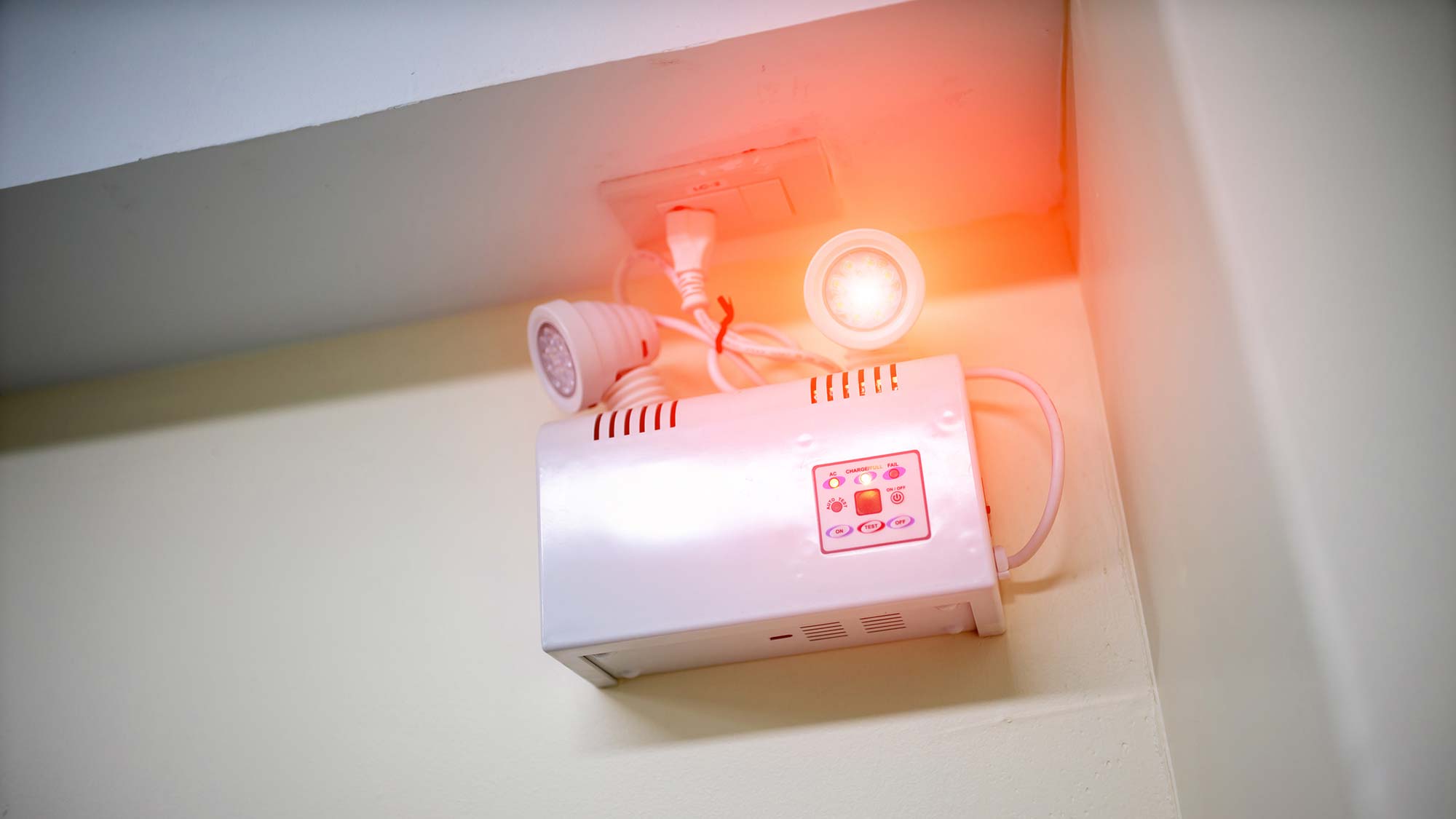
Choosing the Right Emergency Power System for Healthcare Facilities
Every hospital needs reliable emergency power, but how you deliver it is a critical design choice. Two of the most common approaches—Central Battery Systems and Distributed Inverters—each offer unique benefits depending on the type of space, budget, and operational priorities.
Central Battery Systems: One Hub for Many Fixtures
Central battery systems use a single, room-sized inverter and battery bank to feed multiple emergency circuits. This setup provides several advantages:
- Fast Transfer: “No-break” models can relight luminaires in under 2 ms—critical for ORs and ICUs where any outage is unacceptable.
- Centralized Maintenance: All batteries are in one conditioned room, making inspections and integration with the building management system easier.
- Cost Efficiency: Lower cost per fixture, a single test point, and spare capacity for future loads offset future labor.
- Testing & Records: Remote panels automate NFPA’s monthly 30-second and annual 90-minute tests, producing a single downloadable log for Joint Commission audits.
Best fit for:
- New towers or floors with many emergency and task fixtures.
- Spaces where zero interruption is non-negotiable (e.g., ORs, ICUs).
Distributed Inverters: Flexibility at the Fixture Level
Distributed inverters place small units at the circuit or even luminaire level. They’re ideal when renovations or phased upgrades make pulling new homeruns costly:
- Flexible Installation: Units fit above ceilings, in closets, or within fixtures—minimal HVAC impact.
- Zero Transfer for Normally-Off Luminaires: Fixture-level packs deliver instant relight.
- Scalable Upgrades: Add units as spaces convert without oversizing a main battery room.
- Isolated Failures: If one inverter fails, only that zone or fixture is affected—others stay lit.
Best fit for:
- Phased renovation projects in scattered wings.
- Outpatient wings or mobile units.
- Budget-conscious upgrades over time.
Compliance & Code Essentials
No matter which approach you choose, your emergency power system must meet life-safety codes:
- NFPA 101 Life-Safety Code: Luminaires must relight within 10 seconds and stay on ≥90 minutes.
- NFPA 99 Essential Electrical System (EES): Splits loads into Life-Safety, Critical, and Equipment branches.
- NEC Article 517: Requires separate automatic-transfer switches and wiring for each branch.
- Joint Commission: Monthly 30-second functional tests and annual 90-minute load tests are auditable.
How LiteSource Helps
LiteSource works with leading manufacturers to translate complex code requirements into clear fixture specs. Our healthcare team provides:
- Single-source emergency lighting solutions.
- Fast, accurate quotes.
- Support from design through post-installation.
Download the full Healthcare Emergency Power: Central Battery vs. Distributed Inverters” guide to see all the specs and scenarios in one place, and contact us at [email protected] or 919.555.0123 to discuss compliant, safe, and reliable emergency lighting for your space.